.
In this manner, what is the shape of the planets revolutions?
rotating planets are slightly oblate spheres, while tidally locked satellites are triaxial.
Similarly, can planets be different shapes? Planets can actually be triangular, or square, or even pentagonal in shape in theory. And in principle they can also be donut shaped too, with a hole in the middle - a stable configuration though one that is easily disturbed so there probably aren't that many donut shaped planets in the universe :).
Likewise, how come all the planets are round?
All of the planets are round because of gravity. When our Solar System was forming, gravity gathered billions of pieces of gas and dust into clumps which grew larger and larger to become the planets. The force of the collision of these pieces caused the newly forming planets to become hot and molten.
Which model is similar shape with our solar system?
The Bohr model—or solar system model—of the atom describes atoms as consisting of a nucleus with a number of electrons in orbits around that nucleus, similar to a solar system.
Related Question AnswersHow many rings does Earth have?
It has two rings, perhaps due to a collision that caused a chain of debris to orbit it.What type of planet is Earth?
A terrestrial planet, telluric planet, or rocky planet is a planet that is composed primarily of silicate rocks or metals. Within the Solar System, the terrestrial planets are the inner planets closest to the Sun, i.e. Mercury, Venus, Earth, and Mars.Which planet is closest to Earth?
The answer most people would give is Venus. But … it might actually be Mercury. Although Venus is the planet that comes closest to Earth as it sweeps by on its orbit, Mercury stays the closest to Earth the longest, according to a commentary published Tuesday (March 12) in the magazine Physics Today.Is the sun moving?
Answer: Yes, the Sun - in fact, our whole solar system - orbits around the center of the Milky Way Galaxy. We are moving at an average velocity of 828,000 km/hr. But even at that high rate, it still takes us about 230 million years to make one complete orbit around the Milky Way!Why is Earth tilted 23.5 degrees?
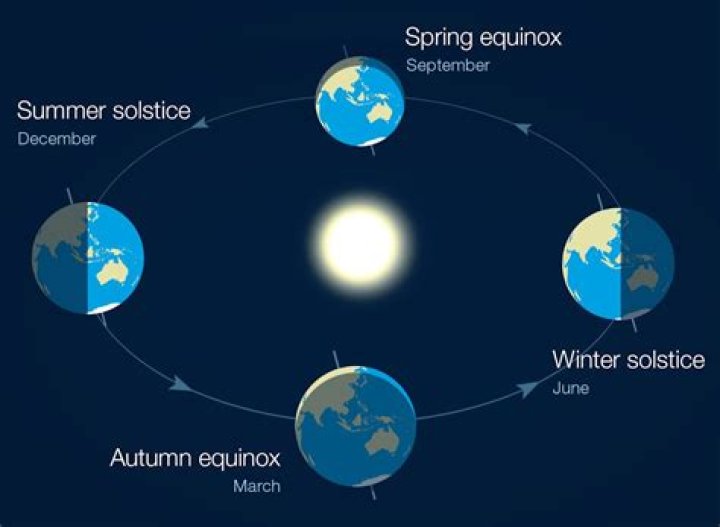
We have seasons because Earth's axis – the imaginary line that goes through the Earth and around which the Earth spins — is tilted. It's tilted about 23.5 degrees relative to our plane of orbit (the ecliptic) around the Sun. As we orbit our Sun, our axis always points to the same fixed location in space.What is Earth made of?
The Earth is made out of many things. Deep inside Earth, near its center, lies Earth's core which is mostly made up of nickel and iron. Above the core is Earth's mantle, which is made up of rock containing silicon, iron, magnesium, aluminum, oxygen and other minerals.Is there water on Venus?
The surface of Venus is extremely dry. During its evolution, ultraviolet rays from the sun evaporated water quickly, keeping the planet in a prolonged molten state. There is no liquid water on its surface today because the scorching heat created by its ozone-filled atmosphere would cause water to boil away.How many rings does Mars have?
According to the model, Phobos will break apart upon reaching the Roche limit, and become a set of rings in roughly 70 million years. Depending on where the Roche limit is, Minton and Hesselbrock believe this cycle may have repeated between three and seven times over billions of years.Why do planets spin?
Our planets have continued spinning because of inertia. In the vacuum of space, spinning objects maintain their momentum and direction — their spin — because no external forces have been applied to stop them. And so, the world — and the rest of the planets in our solar system — keeps spinning.How big is the universe?
The proper distance—the distance as would be measured at a specific time, including the present—between Earth and the edge of the observable universe is 46 billion light-years (14 billion parsecs), making the diameter of the observable universe about 93 billion light-years (28 billion parsecs).What planets are in the Milky Way?
The Solar System is located in the Orion Arm, 26,000 light-years from the center of the Milky Way galaxy.Solar System.
| Planetary system | |
|---|---|
| Stars | 1 (Sun) |
| Known planets | 8 (Mercury Venus Earth Mars Jupiter Saturn Uranus Neptune) |